Showing posts with label Costco. Show all posts

Thursday, July 5, 2012

Tidbit: Nutrition Facts Panel on the bottom?


Why do they do it? Why do food manufacturers put Nutrition Facts panels on the bottom of a package?

These are warehouse store-sized boxes of Cheerios and Kashi wheat squares, with all sorts of room to put the Nutrition info on the side of the box. But it is on the bottom. Do they think people don’t look at these panels?

I can understand why Russell Stover’s and other candy boxes have the nutrition info on the bottom…the manufacturers don’t want to make a big deal about calories of this fun food, and many people don’t really want to think about how many calories they are eating.

But it’s not just calorie counting people who look at these panels. A big part of my job is to teach people to read labels. For people with diabetes, we look at the carbohydrate content of a food portion. For heart disease and high cholesterol, we look at the types of fat in a portion of a food. For allergies, we study the list of ingredients.

So if you really want to know the carbohydrate grams in your cereal, you have to turn the box upside down. No big deal, right? But if the cereal has already been opened, and isn’t securely closed, you can make a huge mess (and may have to toss the part that hits the floor).

Hey Costco, Sam’s Club and other warehouse stores: Can’t you twist the arm of manufacturers and let them know that many of your members would be happier if the food label info was on the side, not the bottom?  Rant over. 

Friday, June 22, 2012

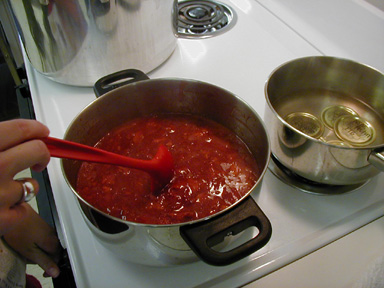
Q & A: Homemade low-sugar jam for diabetes


Photo courtesy of USDA and National Center for Home Food Preservation


Q:   Is there a way to make homemade jam for family members with diabetes? M.P. Grandville, MI

A:   Summer is a great time to take advantage of the fresh local fruit, and preserving them for winter eating.  Yes, there are a number of options for making low-sugar jam from fresh seasonal fruit.   According to Michigan State University Extension, making low-sugar types of jams and jellies is a different process and requires specific recipes. It usually does not work to “wing it” and use regular pectin with less sugar, because the jam will not turn out. Food science (chemistry) is a balance between ingredients.  Bet you never thought of your kitchen as a food laboratory, did you?
  
Here are the options for making low-sugar jams:

Option 1:  Buy the “low sugar” or “light” pectin at the grocery store, and follow the directions on the package insert for best results. This is a different type of pectin (low methoxyl) that thickens jam with a lot less sugar.  In our area, I have seen a light version of Sure Jel and Mrs. Wage’s pectin.  In my opinion, this method has the best flavor.

Option 2: Use regular pectin and add an artificial sweetener.  Use the recipe in the regular pectin for this and follow directions. Some artificial sweeteners such as aspartame do not retain their sweetness in a mixture like this for more than three to four months; don’t plan on it for long-term storage.

Option 3: Use unflavored gelatin as a thickener, by following specific recipes (a couple of recipes using this method are available from the National Center for Home Food Preservation website). This jam must be kept refrigerated.

Option 4:  Boiling or simmering fruit pulp until it thickens and resembles jam. This is similar to the traditional way apple butter is made.

These types of jams have about 5 grams carbohydrate per tablespoon.  Even though you may still be using sugar in the low-sugar jams, it is significantly less sugar, and the carbohydrate content is similar to the light jams available at the grocery store.

Remember, there is also carbohydrate (natural sugar) in the fruit itself, so even if you opted to make a jam with no added sugar, you cannot call it carbohydrate-free or sugar-free.


For those of you who have no time or desire to make your own low-sugar jam, there are some nice options available at the grocery store. I have seen store brand “all fruit” spreads, Smucker’s low-sugar jam, and others. We like the E.D. Smith brand of “More Fruit” preserves (half the calories of regular preserves) found at Costco. There are 6 grams of carbohydrate in one tablespoon (compared to 13 in standard jam).